Early Modern Germany Comprehensive Exam Reading List

HISTORY > Early Modernistic English language (c. 1500 - c. 1800)
Great Vowel Shift Dorsum to Peak
A major factor separating Heart English from Modern English is known as the Corking Vowel Shift, a radical change in pronunciation during the 15th, 16th and 17th Century, equally a result of which long vowel sounds began to be made higher and further forward in the mouth (short vowel sounds were largely unchanged). In fact, the shift probably started very gradually some centuries before 1400, and continued long later 1700 (some subtle changes arguably proceed even to this solar day). Many languages have undergone vowel shifts, but the major changes of the English vowel shift occurred inside the relatively curt infinite of a century or two, quite a sudden and dramatic shift in linguistic terms. Information technology was largely during this short catamenia of time that English lost the purer vowel sounds of nearly European languages, as well as the phonetic pairing between long and curt vowel sounds. Epitome
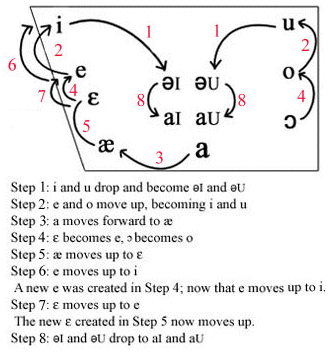
The Groovy Vowel Shift
(from ELLO)
The causes of the shift are still highly debated, although an important factor may take been the very fact of the large intake of loanwords from the Romance languages of Europe during this fourth dimension, which required a unlike kind of pronunciation. It was, notwithstanding, a peculiarly English phenomenon, and contemporary and neighbouring languages like French, German and Spanish were entirely unaffected. It afflicted words of both native ancestry likewise as borrowings from French and Latin.
In Center English (for instance in the time of Chaucer), the long vowels were generally pronounced very much like the Latin-derived Romance languages of Europe (e.one thousand. sheep would have been pronounced more like �shape�; me as �may�; mine as �meen�; shire every bit �sheer�; mate as �maat�; out every bit �oot�; house equally �hoose�; flour equally �floor�; boot every bit �gunkhole�; style as �mood�; etc). William the Conqueror�southward �Domesday Book�, for example, would have been pronounced �doomsday�, equally indeed it is oftentimes erroneously spelled today. Afterward the Keen Vowel Shift, the pronunciations of these and similar words would have been much more like they are spoken today. The Shift comprises a series of connected changes, with changes in one vowel pushing some other to change in gild to "keep its altitude", although there is some dispute as to the order of these movements. The changes also proceeded at dissimilar times and speeds in different parts of the country.
Thus, Chaucer�due south give-and-take lyf (pronounced �leef�) became the modern discussion life, and the discussion five (originally pronounced �feef�) gradually acquired its modern pronunciation. Some of the changes occurred in stages: although lyf was spelled life past the time of Shakespeare in the late 16th Century, it would accept been pronounced more than like �lafe� at that fourth dimension, and only later did it caused its modern pronunciation. Information technology should exist noted, though, that the trend of upper-classes of southern England to pronounce a wide �a� in words like dance, bath and castle (to sound like �dahnce�, �bahth� and �cahstle�) was merely an 18th Century fashionable affectation which happened to stick, and nothing to do with a full general shifting in vowel pronunciation.
The Great Vowel Shift gave rise to many of the oddities of English pronunciation, and now obscures the relationships betwixt many English words and their foreign counterparts. The spellings of some words changed to reverberate the alter in pronunciation (due east.g. rock from stan, rope from rap, nighttime from derk, barn from bern, middle from herte, etc), but most did not. In some cases, two split up forms with different meaning connected (eastward.g. parson, which is the quondam pronunciation of person). The effects of the vowel shift generally occurred before, and were more than pronounced, in the s, and some northern words like uncouth and dour notwithstanding retain their pre-vowel shift pronunciation (�uncooth� and �door� rather than �uncowth� and �dowr�). Busy has kept its old West Midlands spelling, but an Due east Midlands/London pronunciation; bury has a West Midlands spelling but a Kentish pronunciation. Information technology is also due to irregularities and regional variations in the vowel shift that nosotros have ended up with inconsistencies in pronunciation such as food (equally compared to practiced, stood, claret, etc) and roof (which still has variable pronunciation), and the dissimilar pronunciations of the �o� in shove, move, hove, etc.
Other changes in spelling and pronunciation as well occurred during this period. The Erstwhile English consonant Ten - technically a �voiceless velar fricative�, pronounced as in the �ch� of loch or Bach - disappeared from English language, and the Old English discussion bur 10 (identify), for example, was replaced with �-burgh�, �-borough�, �-brough� or �-bury� in many identify names. In some cases, voiceless fricatives began to exist pronounced similar an �f� (e.g. express mirth, cough). Many other consonants ceased to be pronounced at all (e.g. the final �b� in words like dumb and comb; the �fifty� between some vowels and consonants such as half, walk, talk and folk; the initial �chiliad� or �g� in words similar knee, knight, gnaw and gnat; etc). Every bit tardily as the 18th Century, the �r� afterwards a vowel gradually lost its force, although the �r� before a vowel remained unchanged (east.m. render, terror, etc), unlike in American usage where the �r� is fully pronounced.
So, while modernistic English speakers tin can read Chaucer�due south Middle English (with some difficulty admittedly), Chaucer�s pronunciation would take been well-nigh completely unintelligible to the modern ear. The English language of William Shakespeare and his contemporaries in the late 16th and early on 17th Century, on the other paw, would exist absolute, simply quite understandable, and it has much more in common with our linguistic communication today than it does with the language of Chaucer. Even in Shakespeare�southward time, though, and probably for quite some time afterwards, short vowels were well-nigh interchangeable (east.g. non was oftentimes pronounced, and even written, equally nat, when as whan, etc), and the pronunciation of words like boiled every bit �byled�, join as �jine�, poison every bit �pison�, merchant equally �marchant�, certain as �sartin�, person equally �parson�, heard as �hard�, speak as �spake�, work as �wark�, etc, continued well into the 19th Century. We retain fifty-fifty today the one-time pronunciations of a few words similar derby and clerk (equally �darby� and �clark�), and place names similar Berkeley and Berkshire (as �Barkley� and �Barkshire�), except in America where more than phonetic pronunciations were adopted.
The English language Renaissance Back to Acme
The next wave of innovation in English vocabulary came with the revival of classical scholarship known every bit the Renaissance. The English Renaissance roughly covers the 16th and early 17th Century (the European Renaissance had begun in Italy equally early as the 14th Century), and is oft referred to every bit the �Elizabethan Era� or the �Age of Shakespeare� afterwards the most of import monarch and most famous author of the period. The additions to English vocabulary during this catamenia were deliberate borrowings, and not the effect of whatsoever invasion or influx of new nationalities or any height-down decrees. IMAGE
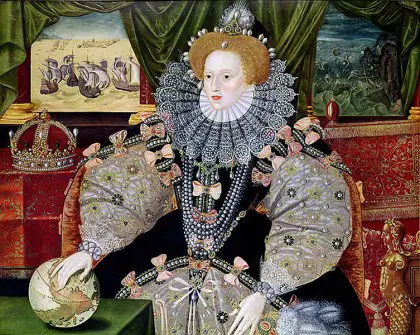
Queen Elizabeth I presided over the English language Renaissance
(from Wikipedia)
Latin (and to a lesser extent Greek and French) was still very much considered the linguistic communication of education and scholarship at this time, and the nifty enthusiasm for the classical languages during the English Renaissance brought thousands of new words into the language, peaking around 1600. A huge number of classical works were being translated into English language during the 16th Century, and many new terms were introduced where a satisfactory English equivalent did not exist.
Words from Latin or Greek (oftentimes via Latin) were imported wholesale during this catamenia, either intact (e.g. genius, species, militia, radius, specimen, benchmark, squalor, appliance, focus, tedium, lens, antenna, paralysis, nausea, etc) or, more commonly, slightly contradistinct (e.g. horrid, pathetic, iilicit, pungent, frugal, anonymous, dislocate, explain, excavate, meditate, adjust, enthusiasm, absurdity, area, complex, concept, invention, technique, temperature, sheathing, premium, arrangement, expensive, notorious, gradual, habitual, insane, ultimate, agile, fictitious, physician, anatomy, skeleton, orbit, atmosphere, catastrophe, parasite, manuscript, lexicon, comedy, tragedy, anthology, fact, biography, mythology, sarcasm, paradox, chaos, crunch, climax, etc). A whole category of words catastrophe with the Greek-based suffixes �-ize� and �-ism� were too introduced effectually this time.
Sometimes, Latin-based adjectives were introduced to plug "lexical gaps" where no describing word was available for an existing Germanic noun (e.g. marine for sea, pedestrian for walk), or where an existing describing word had caused unfortunate connotations (e.grand. equine or equestrian for horsey, aquatic for watery), or but as an additional synonym (e.k. masculine and feminine in add-on to manly and womanly, paternal in improver to fatherly, etc). Several rather ostentatious French phrases also became naturalized in English at this juncture, including soi-disant, vis-�-vis, sang-froid, etc, besides every bit more than mundane French borrowings such equally cr�pe, �tiquette, etc.
| IMAGE |
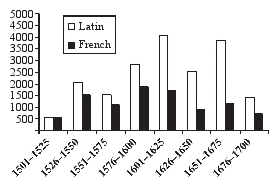 Early on Modern English loans from Latin & French (from Scribd, originally from T. Nevaleinen "An Introduction to Early on Modern English") |
However, information technology is interesting to note that some words initially branded as inkhorn terms take stayed in the linguistic communication and now remain in common use (e.one thousand. dismiss, disagree, celebrate, encyclopaedia, commit, industrial, affability, dexterity, superiority, external, exaggerate, extol, necessitate, expectation, mundane, capacity and ingenious). An indication of the arbitrariness of this process is that impede survived while its opposite, expede, did not; commit and transmit were allowed to continue, while demit was non; and disabuse and disagree survived, while disaccustom and disacquaint, which were coined around the aforementioned fourth dimension, did not. Information technology is also sobering to realize that some of the greatest writers in the language have suffered from the same vagaries of style and fate. Not all of Shakespeare�s many creations have stood the test of time, including barky, brisky, conflux, exsufflicate, ungenitured, unhair, questrist, cadent, perisive, abruption, appertainments, implausive, vastidity and tortive. Too, Ben Jonson�s ventositous and obstufact died a premature death, and John Milton�south impressive inquisiturient has too not lasted.
There was fifty-fifty a self-conscious reaction to this perceived foreign incursion into the English linguistic communication, and some writers tried to deliberately resurrect older English words (e.m. gleeman for musician, sicker for certainly, inwit for conscience, yblent for dislocated, etc), or to create wholly new words from Germanic roots (e.g. endsay for conclusion, yeartide for ceremony, foresayer for prophet, forewitr for prudence, loreless for ignorant, gainrising for resurrection, starlore for astronomy, fleshstrings for muscles, grosswitted for stupid, speechcraft for grammar, birdlore for ornithology, etc). Well-nigh of these were also short-lived. John Cheke even made a valiant attempt to interpret the unabridged "New Testament" using but native English words.
The 17th Century penchant for classical language too influenced the spelling of words like debt and doubtfulness, which had a silent �b� added at this time out of deference to their Latin roots (debitum and dubitare respectively). For the aforementioned reason, island gained its silent �s�, scissors its �c�, anchor, schoolhouse and herb their �h�, people its �o� and victuals gained both a �c� and a �u�. In the same fashion, Middle English language perfet and verdit became perfect and verdict (the added �c� at to the lowest degree being pronounced in these cases), faute and assaut became error and assault, and aventure became adventure. However, this perhaps commendable effort to bring logic and reason into the apparent chaos of the language has really had the effect of just adding to the anarchy. Its crusade was not helped past examples such the �p� which was added to the start of ptarmigan with no etymological justification whatever other than the fact that the Greek word for feather, ptera, started with a "p".
Whichever side of the debate 1 favours, however, it is fair to say that, by the end of the 16th Century, English had finally become widely accepted equally a linguistic communication of learning, equal if non superior to the classical languages. Colloquial language, once scorned as suitable for pop literature and fiddling else - and still criticized throughout much of Europe every bit crude, limited and young - had become recognized for its inherent qualities.
Printing Press and Standardization Back to Peak
The final major factor in the development of Modern English was the advent of the printing press, one of the world�southward slap-up technological innovations, introduced into England by William Caxton in 1476 (Johann Gutenberg had originally invented the printing press in Germany around 1450). The first book printed in the English language was Caxton's own translation, �The Recuyell of the Historyes of Troye�, actually printed in Bruges in 1473 or early 1474. Up to 20,000 books were printed in the following 150 years, ranging from mythic tales and popular stories to poems, phrasebooks, devotional pieces and grammars, and Caxton himself became quite rich from his press business (among his best sellers were Chaucer�s �Canterbury Tales� and Thomas Malory�s �Tales of King Arthur�). As mass-produced books became cheaper and more than unremarkably available, literacy mushroomed, and soon works in English language became even more popular than books in Latin. IMAGE
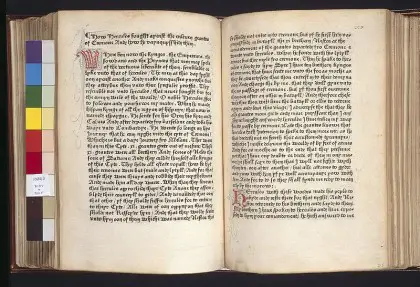
The outset volume printed in English was �Recuyell of the Historyes of Troye� past Raoul Lefevre, translated by William Caxton in 1473
(from John Rylands University Library)
At the fourth dimension of the introduction of printing, there were 5 major dialect divisions inside England - Northern, Westward Midlands, East Midlands (a region which extended down to include London), Southern and Kentish - and even inside these demarcations, there was a huge diversity of different spellings. For example, the word church could be spelled in xxx different means, people in 22, receive in 45, she in sixty and though in an almost unbelievable 500 variations. The �-ing� participle (e.g. running) was said as �-and� in the n, �-cease� in the East Midlands, and �-ind� in the West Midlands (due east.g. runnand, runnend, runnind). The "-eth" and "-th" verb endings used in the due south of the country (east.g. goeth) appear as "-es" and "-s" in the Northern and most of the n Midland area (e.g. goes), a version which was ultimately to become the standard.
The Chancery of Westminster made some efforts from the 1430s onwards to set standard spellings for official documents, specifying I instead of ich and various other common variants of the outset person pronoun, land instead of lond, and modern spellings of such, right, non, but, these, any, many, tin can, cannot, but, shall, should, could, ought, thorough, etc, all of which previously appeared in many variants. Chancery Standard contributed significantly to the development of a Standard English language, and the political, commercial and cultural dominance of the "E Midlands triangle" (London-Oxford-Cambridge) was well established long earlier the 15th Century, but it was the printing press that was really responsible for carrying through the standardization process. With the advent of mass press, the dialect and spelling of the East Midlands (and, more specifically, that of the national capital, London, where nearly publishing houses were located) became the de facto standard and, over time, spelling and grammar gradually became more and more fixed.
| IMAGE |
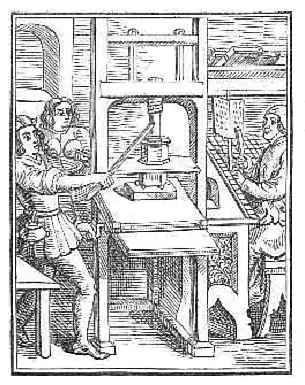 Early printing was a very labour-intensive process (from EHistLing) |
A good part of the reason for many of the vagaries and inconsistencies of English spelling has been attributed to the fact that words were stock-still on the printed folio before any orthographic consensus had emerged amongst teachers and writers. Printing also directly gave rise to some other strange quirk: the give-and-take the had been written for centuries equally �e, using the thorn graphic symbol of Quondam English language, but, equally no runic characters were available on the European printing presses, the alphabetic character �y� was used instead (being closest to the handwritten thorn character of the catamenia), resulting in the discussion ye, which should therefore technically still be pronounced as �the�. It is merely since the archaic spelling was revived for store signs (e.g. Ye Olde Pubbe) that the "modern" pronunciation of ye has been used.
As the Early Modernistic period progressed, in that location was an increased use of double vowels (e.g. presently) or a silent final "e" (e.g. name) to mark long vowels, and doubled consonants to mark a preceding short vowel (east.g. sitting), although there was much less consensus about consonants at the end of words (eastward.grand. bed, glad, well, glasse, etc). The letters "u" and "v", which had been more or less interchangeable in Middle English, gradually became established as a vowel and a consonant respectively, as did "i" and "j". Likewise during the 16th Century, the virgule (an oblique stroke /), which had been a very mutual mark of punctuation in Eye English, was largely replaced by the comma; the period or total-end was restricted to the cease of sentences; semi-colons began to exist used in additon to colons (although the rules for their utilise were withal unclear); quotation marks were used to mark direct speech; and capital letters were used at the start of sentences and for proper names and important nouns. The grammarian John Hart was peculiarly influential in these punctuation reforms.
Standardization was well under way by effectually 1650, but it was a ho-hum and halting process and names in particular were often rendered in a diverseness of ways. For instance, more than 80 unlike spellings of Shakespeare�s name have been recorded, and he himself spelled it differently in each of his six known signatures, including two different versions in his ain will!
Two particularly influential milestones in English literature were published in the 16th and early 17th Century. In 1549, the �Book of Common Prayer� (a translation of the Church building liturgy in English language, substantially revised in 1662) was introduced into English churches, followed in 1611 by the Authorized, or Rex James, Version of �The Bible�, the culmination of more two centuries of efforts to produce a Bible in the native language of the people of England. As we saw in the previous department, John Wycliffe had made the commencement English translation of �The Bible� as early as 1384, and illicit handwritten copies had been circulating ever since. But, in 1526, William Tyndale printed his New Testament, which he had translated straight from the original Greek and Hebrew. Tyndale printed his �Bible� in secrecy in Germany, and smuggled them into his homeland, for which he was hounded down, constitute guilty of heresy and executed in 1536. By the fourth dimension of his death he had merely completed role of the Old Attestation, merely others carried on his labours. Tyndale�southward �Bible� was much clearer and more poetic than Wycliffe�s early version. In addition to completely new English words like fisherman, landlady, scapegoat, taskmaster, viper, sea-shore, zealous, beautiful, clear-eyed, broken-hearted and many others, it includes many of the well-known phrases after used in the King James Version, such as let there be light, my brother�southward keeper, the powers that be, fight the practiced fight, the apple of mine eye, flowing with milk and dear, the fat of the country, am I my brother�s keeper?, sign of the times, ye of piffling faith, eat drink and be merry, salt of the globe, a human being after his own heart, sick unto death, the spirit is willing merely the mankind is weak, a stranger in a strange land, let my people get, a law unto themselves, etc. Ironically, a scant few years after Tyndale�s execution, Henry Eight�s split with Roman Catholicism completely changed official attitudes to an English �Bible�, and by 1539 the idea was existence wholeheartedly encouraged, and several new English language Bibles were published (including the �Coverdale Bible�, the �Matthew Bible�, the �Great Bible�, the �Geneva Bible�, the �Bishops Bible�, etc). The �Male monarch James Bible� was compiled past a committee of 54 scholars and clerics, and published in 1611, in an attempt to standardize the plethora of new Bibles that had sprung up over the preceding 70 years. It appears to exist deliberately bourgeois, fifty-fifty backward-looking, both in its vocabulary and its grammer, and presents many forms which had already largely fallen out of use, or were at least in the process of dying out (e.g. digged for dug, gat and gotten for got, bare for bore, spake for spoke, clave for fissure, holpen for helped, wist for knew, etc), and several archaic forms such as brethren, kine and twain. The "-eth" ending is used throughout for 3rd person singular verbs, even though "-es" was becoming much more common by the early 17th Century, and ye is used for the 2nd person plural pronoun, rather than the more common yous. The comparing below of the famous Beatitudes from Chapter v of the Gospel Co-ordinate to St. Matthew (in the Wycliffe, Tyndale and Authorized versions respectively) gives an idea of the way the linguistic communication developed over the period: Although the majority of the King James Version was quite clearly based on Tyndale�s (up to 80% of the New Testament and much of the Quondam Testament), it is often considered a masterpiece of the English language, and many phrases from it have become well-used in every mean solar day speech. It is however considered past many to be the definitive English version of �The Bible�, and its iconic opening lines �In the beginning God created the heaven and the globe� are well known, as are many of its phrases (in add-on to those borrowed from Tyndale), including how are the mighty fallen, the root of the matter, to every affair there is a flavor, aptitude their swords into ploughshares, fix your house in order, exist horribly agape, go thee behind me, turned the earth upside downwardly, a thorn in the flesh, etc. Much of its existent power, though, was in exposing the written language to many more than of the common people.
2. And he openyde his mouth, and tauyte hem, and seide,
3. Blessed ben pore men in spirit, for the kyngdom of heuenes is herne.
4. Blessid ben mylde men, for thei schulen welde the erthe.
5. Blessid ben thei that mornen, for thei schulen be coumfortid.
6. Blessid ben thei that hungren and thristen riytwisnesse, for thei schulen be fulfillid.
vii. Blessid ben merciful men, for thei schulen gete merci.
8. Blessid ben thei that ben of clene herte, for thei schulen se God.
nine. Blessid ben pesible men, for thei schulen be clepid Goddis children.
10. Blessid ben thei that suffren persecusioun for riytfulnesse, for the kingdam of heuenes is herne.
2. And he opened hys mouthe, and taught them sayinge:
iii. Blessed are the povre in sprete: for theirs is the kyngdome of heven.
4. Blessed are they that morne: for they shalbe comforted.
5. Blessed are the meke: for they shall inheret the erth.
6. Blessed are they which honger and thurst for rightewesnes: for they shalbe filled.
7. Blessed are the mercifull: for they shall obteyne mercy.
8. Blest are the pure in herte: for they shall se God.
9. Blessed are the peacemakers: for they shalbe called the chyldren of God.
x. Blessed are they which suffre persecucion for rightwesnes sake: for theirs ys the kyngdome of heuen.
2. And he opened his mouth, and taught them, saying:
3. Blest are the poore in spirit: for theirs is the kingdome of heauen.
4. Blessed are they that mourne: for they shall be comforted.
five. Blest are the meeke: for they shall inherit the earth.
6. Blessed are they which doe hunger and thirst after righteousnesse: for they shall be filled.
7. Blessed are the mercifull: for they shall obtaine mercie.
viii. Blessed are the pure in heart: for they shall come across God.
9. Blessed are the peacemakers: for they shall bee called the children of God.
10. Blessed are they which are persecuted for righteousnesse sake: for theirs is the kingdome of heauen.
The beginning English dictionary, �A Table Alphabeticall�, was published past English schoolteacher Robert Cawdrey in 1604 (8 years earlier the first Italian lexicon, and 35 years before the commencement French dictionary, although admittedly some 800 years after the kickoff Arabic lexicon and nearly 1,000 after the first Sanskrit dictionary). Cawdrey�south footling volume independent 2,543 of what he called �hard words�, particularly those borrowed from Hebrew, Greek, Latin and French, although information technology was non actually a very reliable resource (even the word words was spelled in two different means on the title folio alone, as wordes and words). Several other dictionaries, every bit well as grammar, pronunciation and spelling guides, followed during the 17th and 18th Century. The outset endeavour to list ALL the words in the English linguistic communication was �An Universall Etymological English Dictionary�, compiled by Nathaniel Bailey in 1721 (the 1736 edition contained nearly 60,000 entries). But the showtime dictionary considered annihilation similar reliable was Samuel Johnson�southward �Lexicon of the English language Linguistic communication�, published in 1755, over 150 years after Cawdrey�s. An impressive academic achievement in its ain right, Johnson�s 43,000 word dictionary remained the pre-eminent English dictionary until the much more comprehensive �Oxford English Dictionary� 150 more years later on, although information technology was really riddled with inconsistencies in both spelling and definitions. Johnson�south dictionary included many flagrant examples of inkhorn terms which have not survived, including digladation, cubiculary, incompossibility, clancular, denominable, opiniatry, ariolation, assation, ataraxy, deuteroscopy, disubitary, esurine, estuation, indignate and others. Johnson too deliberately omitted from his dictionary several words he disliked or considered vulgar (including bang, budge, fuss, gambler, shabby and touchy), simply these useful words have clearly survived intact regardless of his opinions. Several of his definitions appear deliberately jokey or politically motivated. Since the 16th Century, in that location had been calls for the regulation and reform of what was increasingly seen equally an unwieldy English language, including John Cheke'due south 1569 proposal for the removal of all silent letters, and William Bullokar'due south 1580 recommendation of a new 37-alphabetic character alphabet (including 8 vowels, 4 "half-vowels" and 25 consonants) in order to assist and simplify spelling. There were even attempts (similarly unsuccessful) to ban sure words or phrases that were considered in some way undesirable, words such as fib, banter, bigot, fop, brassy, flimsy, workmanship, selfsame, despoil, nowadays, furthermore and wherewithal, and phrases such as subject field matter, drive a bargain, handle a subject and bolster an statement. But, past the early 18th Century, many more scholars had come up to believe that the English linguistic communication was chaotic and in desperate need of some firm rules. Jonathan Swift, in his �Proposal for Correcting, Improving and Ascertaining the English Tongue� of 1712, decried the �degeneration� of English language and sought to �purify� it and prepare it forever in unchanging form, calling for the establishment of an Academy of the English Language like to the Acad�mie Fran�aise. He was supported in this by other important writers like John Dryden and Daniel Defoe, but such an institution was never actually realized. (Interestingly, the only country ever to gear up upwardly an Academy for the English language language was South Africa, in 1961). In the wake of Johnson�south �Dictionary�, a plethora (one could fifty-fifty say a surfeit) of other dictionaries appeared, peaking in the period between 1840 and 1860, too equally many specialized dictionaries and glossaries. Thomas Sheridan attempted to tap into the zeitgeist, and looked to regulate English language pronunciation as well as its vocabulary and spelling. His book �British Education�, published in 1756, and unashamedly aimed at cultured British lodge, particularly cultured Scottish order, purported to set up the correct pronunciation of the English linguistic communication, and it was both influential and pop. His son, Richard Brinsley Sheridan, later gave us the unforgettable language excesses of Mrs. Malaprop. In add-on to dictionaries, many English grammars started to appear in the 18th Century, the best-known and most influential of which were Robert Lowth's �A Short Introduction to English language Grammar� (1762) and Lindley Murray'due south �English language Grammar� (1794). In fact, some 200 works on grammar and rhetoric were published between 1750 and 1800, and no less than 800 during the 19th Century. Most of these works, Lowth�due south in particular, were extremely prescriptive, stating in no uncertain terms the �right� manner of using English. Lowth was the main source of such "right" grammar rules as a double negative always yields a positive, never cease a judgement with a preposition and never split an infinitive. A refreshing exception to such prescriptivism was the �Rudiments of English language Grammar� past the scientist and polymath Joseph Priestley, which was unusual in expressing the view that grammar is defined by common usage and not prescribed past self-styled grammarians. The kickoff English newspaper was the �Courante� or �Weekly News� (actually published in Amsterdam, due to the strict printing controls in force in England at that time) arrived in 1622, and the beginning professional newspaper of public record was the �London Gazette�, which began publishing in 1665. The first daily, �The Daily Courant�, followed in 1702, and �The Times� of London published its first edition in 1790, around the same time as the influential periodicals �The Tatler� and �The Spectator�, which between them did much to plant the manner of English in this period.
Dictionaries and Grammars Dorsum to Top
Golden Historic period of English Literature Dorsum to Tiptop
All languages tend to get through phases of intense generative action, during which many new words are added to the linguistic communication. One such peak for the English linguistic communication was the Early Modern period of the 16th to 18th Century, a period sometimes referred to equally the Golden Age of English language Literature (other peaks include the Industrial Revolution of the late 18th and early on 19th Century, and the computer and digital age of the late 20th Century, which is nonetheless continuing today). Between 1500 and 1650, an estimated 10,000-12,000 new words were coined, about half of which are still in apply today. Image
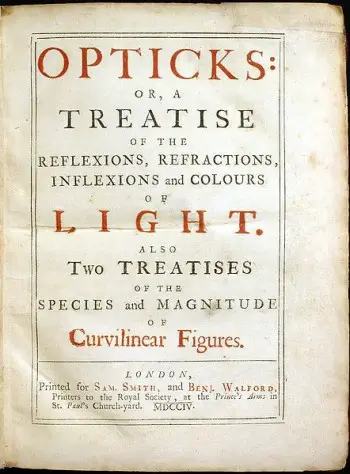
Newton's �Opticks� was published in English language
(from Wikipedia)
Upwards until the 17th Century, English was rarely used for scholarly or scientific works, as it was not considered to possess the precision or the gravitas of Latin or French. Thomas More, Isaac Newton, William Harvey and many other English scholars all wrote their works in Latin and, even in the 18th Century, Edward Gibbon wrote his major works in French, and only and then translated them into English. Sir Francis Bacon, even so, hedged his bets and wrote many of his works in both Latin and English and, taking his inspiration mainly from Greek, coined several scientific words such as thermometer, pneumonia, skeleton and encyclopaedia. In 1704, Newton, having written in Latin until that time, chose to write his �Opticks� in English, introducing in the process such words every bit lens, refraction, etc. Over time, the ascension of nationalism led to the increased utilise of the native spoken linguistic communication rather than Latin, even equally the medium of intellectual communication.
Thomas Wyatt�south experimentation with unlike poetical forms during the early 16th Century, and particularly his introduction of the sonnet from Europe, ensured that poetry would became the proving ground for several generations of English writers during a golden age of English literature, and Edmund Spenser, William Shakespeare, John Donne, John Milton, John Dryden, Andrew Marvell, Alexander Pope and many other rose to the challenge. Of import English playwrights of the Elizabethan era include Christopher Marlowe, Ben Jonson, John Webster and of course Shakespeare.
The English scholar and classicist Sir Thomas Elyot went out of his way to discover new words, and gave united states of america words like animate, depict, dedicate, esteem, maturity, exhaust and modesty in the early 16th Century. His near contemporary Sir Thomas More contributed absurdity, active, communicate, educational activity, utopia, acceptance, exact, explain, exaggerate and others, largely from Latin roots. Milton was responsible for an estimated 630 discussion coinages, including lovelorn, fragrance and pandemonium. Ben Jonson, a contemporary of Shakespeare, is likewise credited with the introduction of many mutual words, including clammy, defunct, strenuous, clumsy and others; John Donne gave u.s. self-preservation, valediction and others; and to Sir Philip Sydney are attributed bugbear, miniature, eye-pleasing, dumb-stricken, far-fetched and chat in its modern meaning.
It was actually only in the 17th Century that dialects (or at to the lowest degree difference from the fashionable Standard English language of Middlesex and Surrey) began to be considered uncouth and an indication of junior class. However, such dialects provided good comic material for the burgeoning theatre manufacture (a well-known instance existence the �rude mechanicals� of Shakespeare�south �A Midsummer Night�s Dream�) and, paradoxically, many dialect words were introduced into general usage in that way. The word class itself but acquired its mod sociological pregnant in the early 18th Century, but by the finish of the century it had become all-pervasive, to the extent that the mere audio of a Cockney emphasis was enough to brand the speaker as a vagabond, thief or criminal (although in the 19th Century, Charles Dickens was to produce neat literature and sly humour out of just such preconceptions, explicitly using speech communication, vocabulary and accent for commic consequence).
William Shakespeare Back to Meridian
Whatever the claim of the other contributions to this golden age, though, it is clear that one human being, William Shakespeare, single-handedly changed the English language to a significant extent in the late 16th and early 17th Century. Skakespeare took advantage of the relative liberty and flexibility and the protean nature of English at the time, and played free and piece of cake with the already liberal grammatical rules, for instance in his use nouns every bit verbs, adverbs, adjectives and substantives - an early instance of the �verbification� of nouns which mod linguistic communication purists often decry - in phrases such as �he pageants usa�, �it out-herods Herod�, dog them at the heels, the good Brutus ghosted, �Lord Angelo dukes information technology well�, �uncle me no uncle�, etc. Prototype
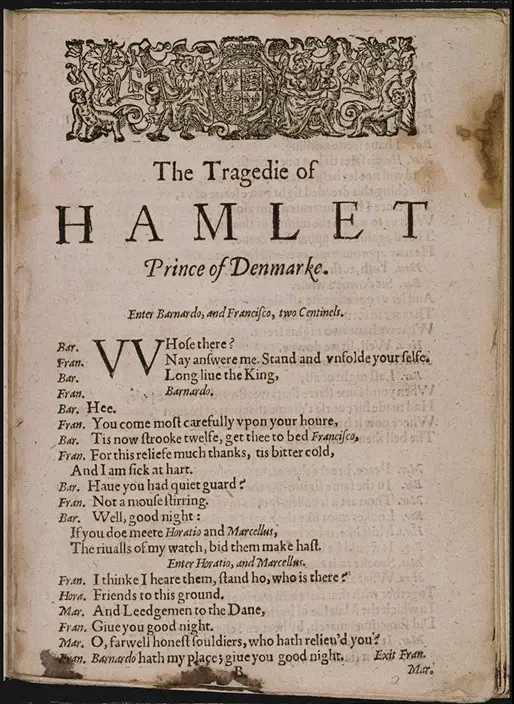
A page from �Hamlet� from Shakespeare's First Page
(from Hamlet on the Ramparts, originally from Folger Shakespeare Library)
He had a vast vocabulary (34,000 words by some counts) and he personally coined an estimated two,000 neologisms or new words in his many works, including, but by no means limited to, blank-faced, critical, leapfrog, monumental, castigate, majestic, obscene, frugal, aeriform, gnarled, homicide, brittle, radiance, dwindle, puking, countless, submerged, vast, lack-lustre, crash-land, cranny, fitful, premeditated, assassination, courtship, eyeballs, sick-tuned, hot-blooded, laughable, dislocate, adaptation, eventful, pell-mell, aggravate, excellent, fretful, fragrant, gust, hint, bustle, lonely, summit, pedant, gloomy, and hundreds of other terms nonetheless commonly used today. Past some counts, almost one in 10 of the words used by Shakespeare were his ain invention, a truly remarkable accomplishment (information technology is the equivalent of a new word hither and and so, after just a few curt phrases, some other other new word here). However, not all of these were necessarily personally invented by Shakespeare himself: they merely appear for the outset fourth dimension in his published works, and he was more than happy to make use of other people�s neologisms and local dialect words, and to mine the latest fashions and fads for new ideas.
He besides introduced countless phrases in common use today, such as ane savage swoop, vanish into sparse air, brave new globe, in my mind�due south middle, laughing stock, honey is blind, star-crossed lovers, as luck would have it, fast and loose, once again into the breach, sea change, there�southward the rub, to the style born, a foregone conclusion, beggars all description, it's Greek to me, a tower of strength, make a virtue of necessity, brevity is the soul of wit, with bated breath, more than in sorrow than in anger, truth volition out, cold comfort, barbarous only to be kind, fool�s paradise and flesh and blood, among many others.
Past the fourth dimension of Shakespeare, word lodge had go more fixed in a subject-verb-object pattern, and English had developed a circuitous auxiliary verb system, although to be was all the same commonly used as the auxiliary rather than the more modernistic to take (eastward.g. I am come rather than I have come). Practice was sometimes used as an auxiliary verb and sometimes not (e.grand. say you so? or do y'all say then?). Past tenses were likewise yet in a state of flux, and it was nonetheless acceptable to use clomb too every bit climbed, clew also equally clawed, shove also as shaved, digged equally well as dug, etc. Plural noun endings had shrunk from the six of Erstwhile English to just two, �-s� and �-en�, and once again Shakespeare sometimes used one and sometimes the other. The old verb ending �-en� had in general been gradually replaced by �-eth� (e.thousand. loveth, doth, hath, etc), although this was itself in the procedure of existence replaced by the northern English verb ending �-es�, and Shakespeare used both (e.g. loves and loveth, but not the sometime loven). Fifty-fifty over the period of Shakespeare�s output there was a noticeable change, with �-eth� endings outnumbering �-es� past over 3 to 1 during the early period from 1591-1599, and �-es� outnumbering �-eth� past over half dozen to 1 during 1600-1613.
A comparison of a passage from "Rex Lear" in the 1623 First Folio with the same passage from a more familiar modern edition beneath gives some idea of some of the changes that were withal underway in Shakespeare'southward time:
| | Sir, I loue you more than words can weild ye matter, Deerer than eye-sight, space, and libertie, Beyond what can be valewed, rich or rare, No lesse then life, with grace, health, beauty, laurels: As much as Childe ere lou'd, or Father institute. A loue that makes breath poore, and speech vnable, Beyond all manner of so much I loue you. | | Sir, I love you more than than give-and-take tin wield the affair, Dearer than eyesight, space, and liberty, Beyond what can be valued, rich or rare, No less than life, with grace, health, beauty, honour, As much as childe eastward'er loved, or father found. A love that makes breath poor and oral communication unable, Beyond all manner of 'so much' I love yous. | |
Other than the spellings of words such equally weild, libertie, valewed and accolade, the most obvious differences from mod-solar day spellings are the continued transposition of of "u" and "5" in loue and vnable, and the abaft silent "e" in lesse, Childe and poore, both hold-overs from Middle English and both in the process of transition at this time. However, it should be remembered that, just equally with Chaucer, the Shakespeare folios we have today were compiled by followers such as John Hemming, Henry Condell and Richard Field, all of whom were not to a higher place making the odd alter or �comeback� to the text, and then we tin never be certain exactly what Shakespeare himself actually wrote.
Thee, g and thy (signifying familiarity or social inferiority, every bit in nearly European languages today) were still very prevalent in Shakespeare�s time, and Shakespeare himself made good use of the subtle social implications of using thou rather than thou. Thee and g had disapeared almost completely from standard usage by the middle of the 17th Century, paradoxically making English i of the least socially conscious of languages. The commonplace letter �e� found at the finish of many medieval English words was likewise start its long pass up by this time, although information technology was retained in many words to indicate the lengthening of the preceding vowel (e.g. proper noun pronounced as �naim�, non equally the Old English �nam-a�). The furnishings of the Great Vowel Shift were underway, but by no means complete, by the fourth dimension of Shakespeare, as can be seen in some of his rhyme schemes (e.m. tea and sea rhymed with say, die rhymed with memory, etc).
While all these of import developments were underway, British naval superiority was besides growing. In the 16th and 17th Century, international trade expanded immensely, and loanwords were absorbed from the languages of many other countries throughout the world, including those of other trading and royal nations such as Spain, Portugal and the Netherlands. Amongst these were:
International Trade Back to Meridian
Source: https://www.thehistoryofenglish.com/history_early_modern.html

Post a Comment for "Early Modern Germany Comprehensive Exam Reading List"